Free · No advice · No bank login required

Can I afford
to retire?

Answer it with real math. Stress-test your plan against inflation, taxes, and market drops. 1,000+ Monte Carlo paths, 81+ Social Security claiming scenarios for couples, and Roth conversion modeling — built on published IRS and SSA formulas. For FIRE planners and on-time retirees alike.

Your data is encrypted. No bank login needed.
Built on published IRS & SSA formulas · Online since 2024
Encryption at rest & in transit
No bank login required
Email-only sign-in · no SSN
Continuous security scanning
No commissions · no data sale
Why planning works
People who plan retire with more — and worry less.
Independent research · sources cited
You're not alone

Half of Americans have never run the numbers.

And the other half? They retire with more clarity, make fewer guesses, and stop wondering if they’ll be okay. The first five minutes are the hardest.
A woman in her late fifties on a coastal boardwalk at sunset, wearing a terracotta linen shirt
1 in 2
Americans have never calculated what they need to retire
EBRI Retirement Confidence Survey, 2024
A man in his late forties on a riverside boardwalk at sunset, city skyline behind him
52%
of workers saved more after calculating their retirement need
EBRI Retirement Confidence Survey, 2024
Calculation, then action

Five minutes of math beats five years of worry.

More than half of workers who ran the numbers ended up saving more. Seeing the gap is what closes it. Clarity drives action — not the other way around.
The most expensive decision

Once you claim Social Security, you’re largely locked in for years to come.

Choosing age 62 vs. 67 vs. 70 swings your monthly check by roughly 75% — and locks in the survivor benefit for your spouse. Model it before you file, not after.
A couple in their fifties smiling at the camera while planning at a kitchen counter with a laptop
37%
of retirees regret when they claimed Social Security
Nationwide Retirement Institute, 2023
What you'll see when you sign in · Free
How long will your money last?
An illustrative comparison: in the example below, retiring at 62 means money runs out around 82, while retiring at 67 keeps the portfolio climbing past 90. Sign up free to run your own — your numbers will differ.
Retire at 62Retire at 67
Portfolio balance over time
Illustrative · base case forecast
$2.5M$2M$1.5M$1M$500K$060657075808590AgeTodayRetire at 62Lasts to age 82Retire at 67Lasts past age 90

Every choice changes your runway. Your free account lets you change retirement age, spending, and Social Security timing — and watch the line redraw.

See your runway

Chart is illustrative. Your actual runway depends on your inputs, market conditions, and decisions. Educational tool — not financial advice.

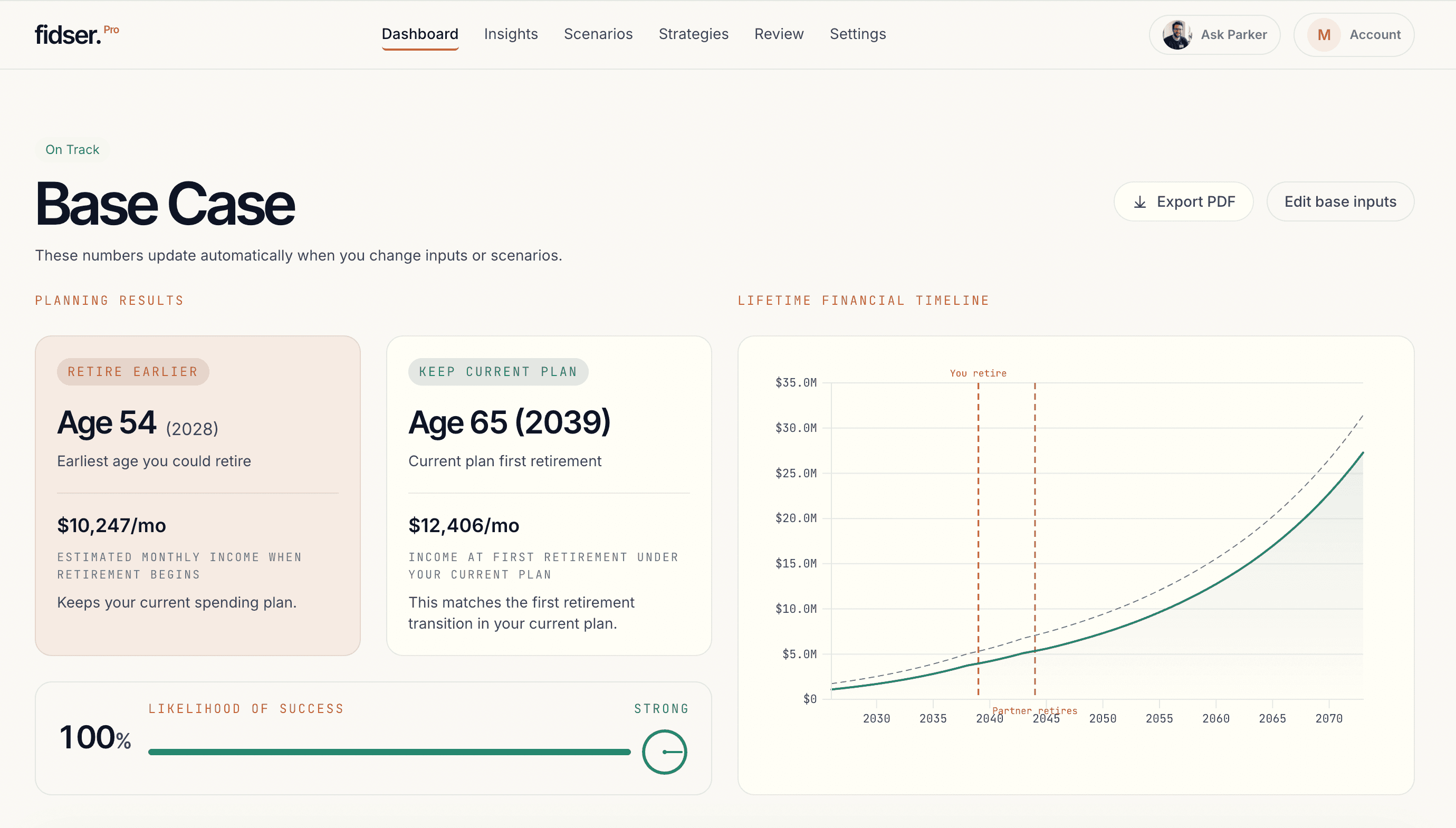
Earliest retirement date · Pro feature
When can I retire?
Free gives you one full forecast for your situation. Pro figures out the soonest you can retire — down to the year — based on your savings, income, and target spending.
Try free, upgrade anytime No credit card · 5 minutes
Your inputs
~5min
Earliest age
61yrs
Success
92%
Illustrative — your numbers will differ.
The questions retirement calculators usually skip.
4 questions · real math
Educational examples — not financial advice.
Q.01
When should I claim Social Security — 62, 67, or 70?
Waiting from 62 to 70 typically grows your monthly check by ~75%. We model 81+ claiming combinations for couples, including spousal and survivor benefits.
Q.02
What about the years between retiring and Medicare at 65?
$172K
Fidelity (2025) puts a 65-year-old couple's lifetime healthcare cost at $172,500. ACA premiums for a 62-year-old can run $1,000–$1,800 a month. We model the pre-Medicare gap, IRMAA surcharges, and Roth conversion timing — so you can see how each one moves the others.
Q.03
What's the best way for us, as a couple, to claim?
81+
We model 81+ combinations across both partners. The higher earner's claim age locks in the survivor benefit for life — most calculators miss this. Spousal and survivor analysis included, with breakeven ages at 85, 90, and 95.
Q.04
What happens when RMDs kick in at 73?
RMDs
At 73, the IRS forces withdrawals from traditional IRAs and 401(k)s. We project your RMDs year-by-year, stack them against Social Security and other income, and model whether earlier Roth conversions soften the tax hit.
1,000+ paths
A single line is a guess.
A cone is an answer.
Every plan runs 1,000+ Monte Carlo simulations accounting for market volatility, inflation, and sequence-of-returns risk.
Spending phases
You won't spend like a 65-year-old when you're 85.
Most calculators assume flat spending for 30 years. Real-world data shows the opposite. We model the natural decline — Go-Go years (full spending), Slow-Go (85%), No-Go (75%) — so the forecast better reflects how retirement typically unfolds.
A retiree walking on the beach — Go-Go years
Go-Go years · age 65–75
Go-Go65–75100%Slow-Go75–8585%No-Go85+75%
Simple, transparent pricing
Free forever. Pro is optional.
Free
$0 forever
  • 50-year inflation-adjusted forecast
  • Social Security claiming calculations
  • Federal and state income tax modeling
  • Healthcare: ACA, Medicare & IRMAA
  • Year-by-year RMD projections
  • 1 household profile
Start free
Pro
$99.50/yr · $8.29/mo
  • Up to 5 what-if scenarios
  • Monte Carlo with sequence-of-returns risk
  • 81+ Social Security combos with spousal & survivor
  • Roth conversion modeling
  • Tax-efficient withdrawal sequencing
  • State-relocation modeling (move mid-plan)
  • Go-Go / Slow-Go / No-Go spending phases
  • Household sharing + PDF export
  • Annual review workflow
Upgrade later
Why we’re free
  • We don't take commissions. We don't sell your data.
  • We don't give advice — that's your advisor's job.
  • Paying members fund the free tier — so it stays free, forever.
  • Published IRS and SSA formulas. We show our work.

Jenny from fidser. customer care
Hi, I'm Jenny
Real questions get real answers.
I help fidser. members find answers fast. If something below doesn't answer your question, email me directly.
Common questions
Plain answers, before you sign up.
Is fidser. financial advice?
No. fidser. is an educational planning tool. It runs the math on the inputs you provide using published IRS and SSA formulas. It doesn't recommend specific investments and it isn't a substitute for an advisor.
Do you connect to my bank or need my SSN?
You don't need to connect a bank account, and we never ask for your SSN. We only ask for an email so you can save your plan and sign back in. You enter the numbers you're comfortable sharing.
Does it work for couples?
Yes — couple planning is built in. You can model two earners, spousal and survivor Social Security benefits, and 81+ claiming combinations across both partners. Pro adds household sharing.
What happens to my data if I cancel or delete my account?
Your plan is encrypted at rest and in transit, and stored behind row-level access controls so only your account can read it. Delete your account and your plan is removed from our database. We never sell data, never take commissions from financial products, and we don't share your information with anyone.
Can I use this with my financial advisor?
Many of our users do. Export a PDF of your plan (Pro) and bring it to your advisor as a starting point — or use the free version to sanity-check what you discussed.
What does "Free forever" actually mean?
The free tier — base case forecast, 50-year projection, Social Security, federal taxes, one household — doesn't expire. There's no trial period and no credit card required. Pro ($99.50/yr) unlocks Monte Carlo, Roth conversions, and what-if scenarios when you want them.

Stop guessing.
Start a free forecast.

Free, forever. Just an email to sign in. fidser. is an educational tool, not a financial advisor. We don't sell data and we don't take commissions.
v4.0 · April 2026For US households planning retirement. Online since 2024. Educational tool, not financial advice.